
API Security Competitive Evaluation — ATI 2026
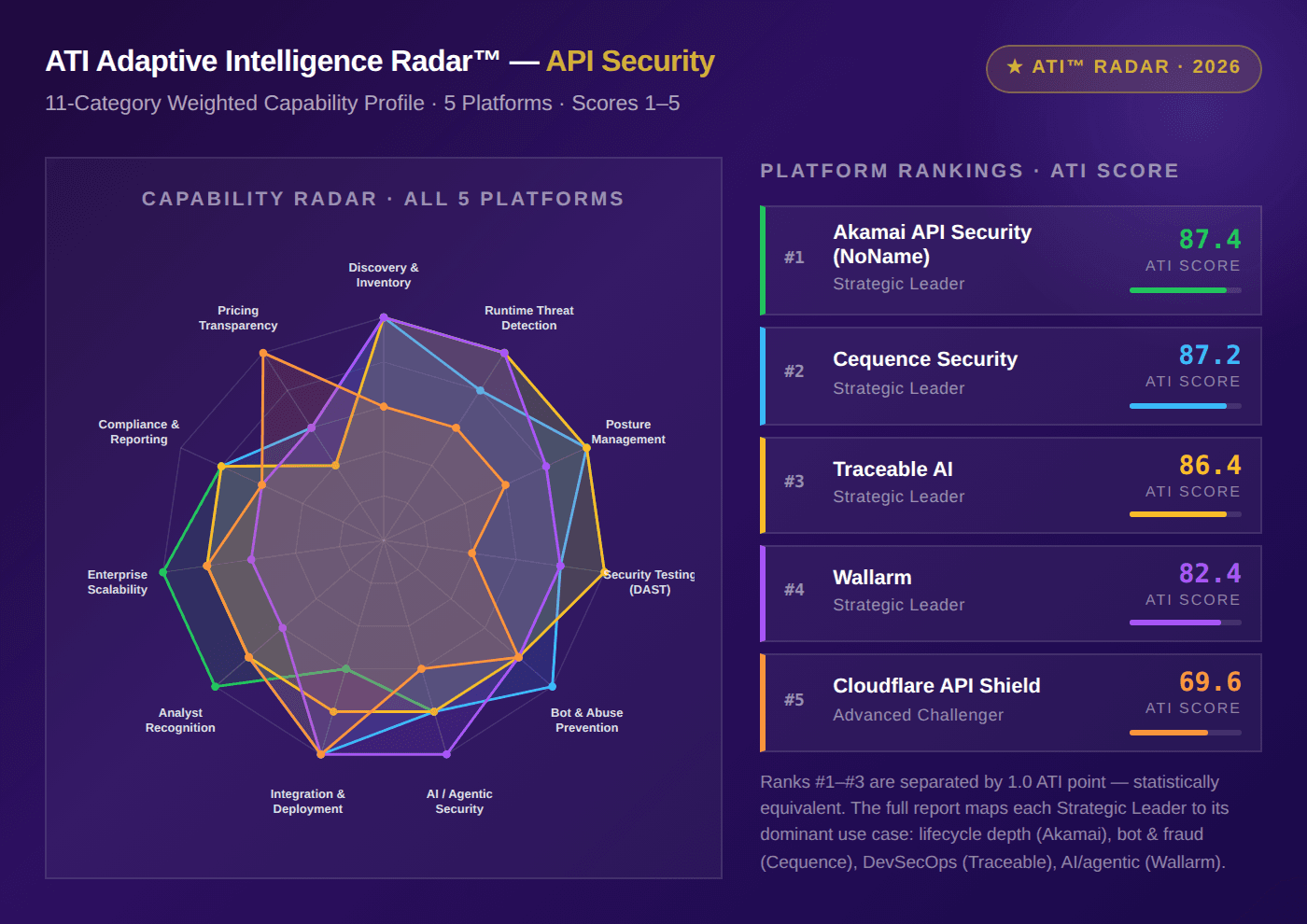
Independent, vendor-neutral evaluation of five leading API security platforms — Akamai API Security (NoName), Cequence Security, Traceable AI, Wallarm, and Cloudflare API Shield — scored across 11 weighted capability categories using the Adaptive Tech Index™ methodology, with industry-specific use case analysis for Healthcare, BFSI, Oil & Gas, Transportation, and Hospitality, plus full PoC and TCO frameworks.
Overview
What this report delivers
An executive-grade procurement reference for CISOs, API security leads, and enterprise architects evaluating API security platforms across multi-cloud, hybrid, and OT environments. The Adaptive Tech Index™ methodology applies an 11-category weighted framework — runtime threat detection, API discovery, posture management, bot prevention, AI/agentic security, and compliance — validated against independent SecureIQlab efficacy testing and five-analyst research coverage, and mapped to PCI DSS v4.0, DORA, HIPAA, GDPR, and NCA UAE mandates. Includes full TCO modelling, a 4-week PoC workplan, and sector-specific threat analysis across five industries.
11
Weighted capability categories
5
Platforms compared head-to-head
3
Composite indices — ATI™ · BRI™ · ORI™
5
Industry verticals analysed
Who this is for
Built for the API security buying committee
CISOs & Security Leaders
Aligning API security investment to PCI DSS v4.0, DORA, HIPAA, GDPR, NCA UAE, and NIS2 mandates across multi-region estates.
API & DevSecOps Engineers
Shortlisting runtime protection and shift-left testing tools for REST, GraphQL, and gRPC API ecosystems — plus agentic AI and MCP workloads.
IT Directors & Procurement
Validating vendor TCO, PoC workplans, and sector-specific use case fit before RFP stage.
Report Structure
22 sections — production-ready intelligence
- 01Executive Summary & ATI Rankings
- 06Breach Resilience Index™ (5-Phase BRI)
- 02API Security Market Overview (57% breach rate)
- 07OWASP & Regulatory Alignment Analysis
- 03Detailed Capability Registry (11 × 5)
- 08Vertical Industry Fit — 5 Sectors
- 04Adaptive Heatmap Benchmark™ (11 × 5)
- 09Commercial & TCO Analysis (3-year model)
- 05ATI Radar™ & Vendor Deep Dives
- 10Deployment Recommendations · Key Findings · PoC Framework
Why it matters
Cut evaluation time, reduce API risk, align to mandates
From RFI to Shortlist in Days, Not Months
Skip months of vendor briefings and PoC scoping. ATI™, BRI™, and ORI™ composite scores across 5 platforms give your team an immediate, evidence-based shortlist — with a ready-to-use PoC workplan included.
Breach Resilience Index™
Unique 5-phase BRI™ framework (Discover → Harden → Detect → Contain → Recover) maps each platform against the API breach lifecycle — grounded in the $4.45M average API breach cost.
Independent, Vendor-Neutral Scoring
No vendor sponsorship. All scores derive from SecureIQlab efficacy testing, five-analyst research coverage (Gartner, Forrester, IDC, KuppingerCole, GigaOm), and verified customer review data.
Depth vs. Deployability, Quantified
The ORI™ inverts the capability ranking — Akamai leads ATI but trails on operational reality, while Cequence tops both charts. Only this report quantifies that trade-off before you commit.
What's included
Deliverables in your purchase
- ✓25-page PDF report (print-ready)
- ✓Editable DOCX (all 22 sections)
- ✓ATI Adaptive Intelligence Radar™ (PNG + PPTX)
- ✓Adaptive Heatmap Benchmark™ (11 × 5 matrix)
- ✓Detailed Capability Registry with category leaders
- ✓Breach Resilience Index™ scorecard
- ✓ATI / BRI / ORI composite rankings
- ✓3-Year TCO model & OpEx guidance
- ✓PoC 4-week workplan & vendor checklist
- ✓6 months of free updates